

Beyond Mothers: Our Alloparental Heritage and Why Fathers Matter
Introducing Featured Author Darby Saxbe


It’s no longer Featured Author February, but we’re thrilled to have one more new Featured Author to add to our lineup: Darby Saxbe.
Darby Saxbe, PhD, is a clinical psychologist and tenured full professor of psychology at the University of Southern California. Her research focuses on the transition to parenthood, particularly the neural and hormonal underpinnings of fatherhood. She integrates neuroscience and psychology to explore how close connections shape health and wellbeing. Her book, Dad Brain: The New Science of Fatherhood and How It Shapes Men’s Lives, will be released in June 2026.
You may recognize Darby’s name from her recent mini-series on whether feminism has been bad for men, featured in our Friday roundup. Here’s what she has to say about Fairer Disputations:
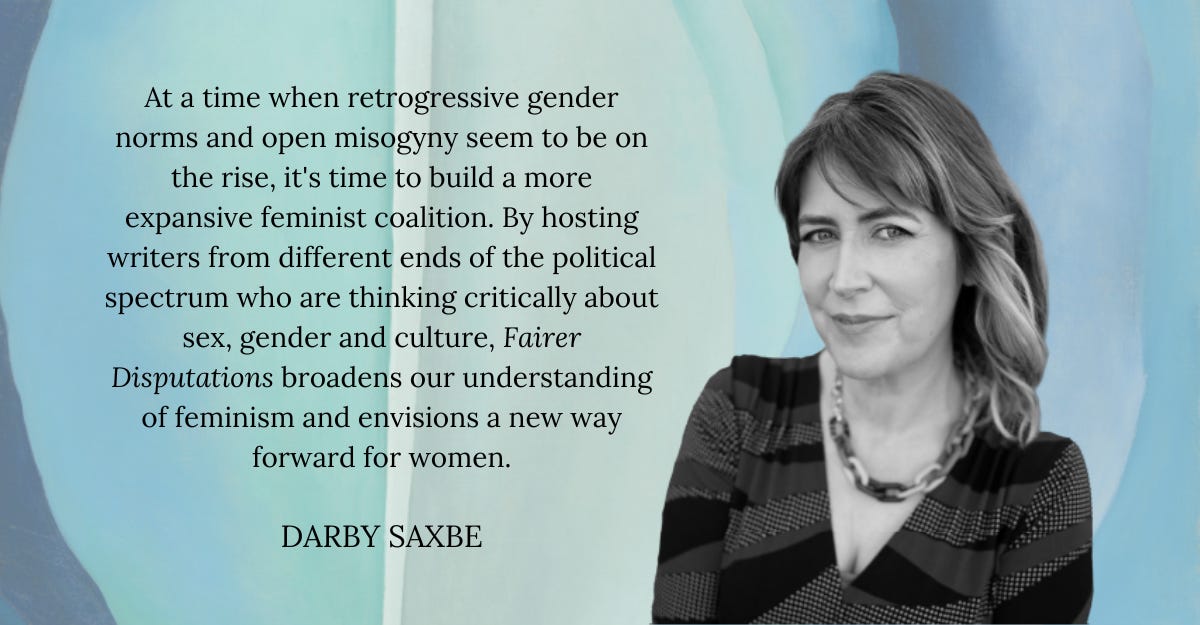
In Darby’s inaugural piece for us, she makes the case that nature intended for fathers to take an active role in their children’s care and development.

Beyond Mothers: Our Alloparental Heritage and Why Fathers Matter
Darby Saxbe
It’s easy to think that mothers are the only caregivers who count. The word “mammal” means “of the breast,” because the unifying feature of our animal class is the ability to produce milk to feed our young. Fittingly, among the majority of mammals, mothers matter most. Males participate in childcare in only five to ten percent of mammalian species. You can find plenty of involved dads in other classes of animals; fathers are primary parents in multiple kinds of bird, frogs, and fish. But finding a hands-on (or paws-on, or hooves-on) father among the mammals is a challenge. There are just a handful of mammal species, mostly rodents and primates, that are truly biparental—that is, species in which both parents get involved in care.
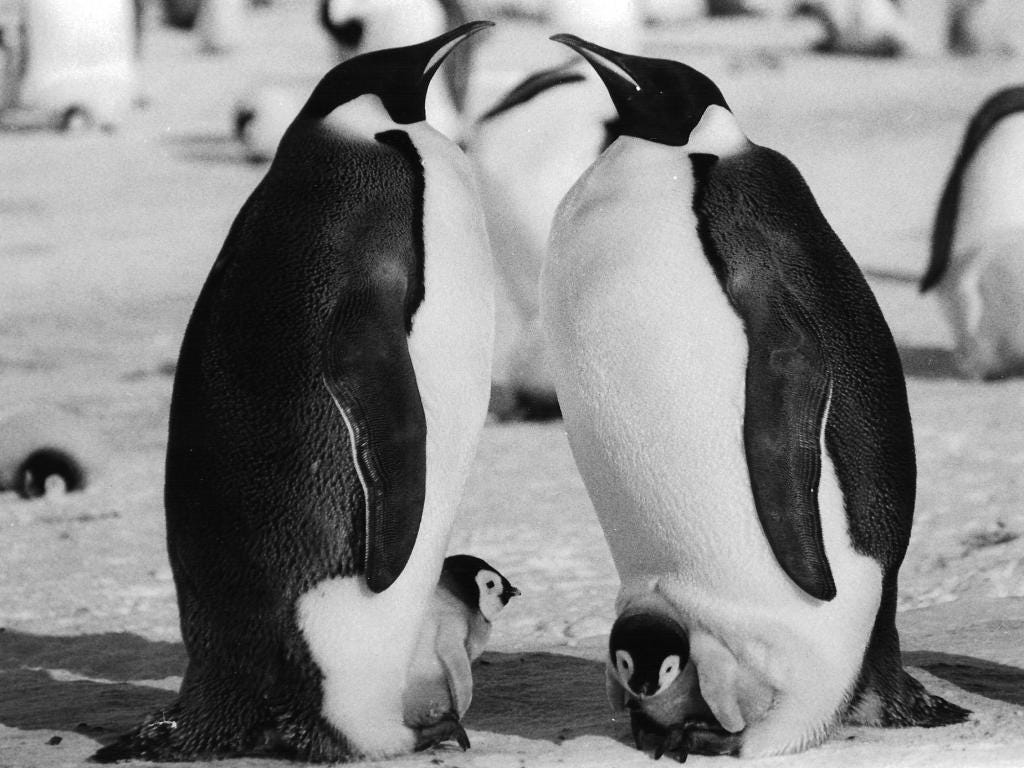
We humans number among those special species in which fathers routinely take part in the care and provisioning of babies and children. Paternal involvement is not just an unusual feature of humanity, but, I’d argue, tells us something fundamental about what it means to be human.
We need dads because human babies are hard to raise. We are born helpless. If you think of pregnancy as an oven, some species of babies come out well-toasted and others emerge underdone, in need of a little more baking time. Biologists call the former group “precocial” and the latter group “altricial.” A precocial animal is born ready to roll; think of an animal that can take its first steps within minutes of birth (like the foal) or find its own way to the ocean and swim (like a sea turtle). Megapodes, a “superprecocial” species of land-dwelling birds that includes the brush turkey, never even meet their parents. They claw their own way out of their eggs, fully feathered, with open eyes, able to forage for food and fly within a day or two of birth. In contrast, altricial animals, like mice and songbirds, are born naked and vulnerable.
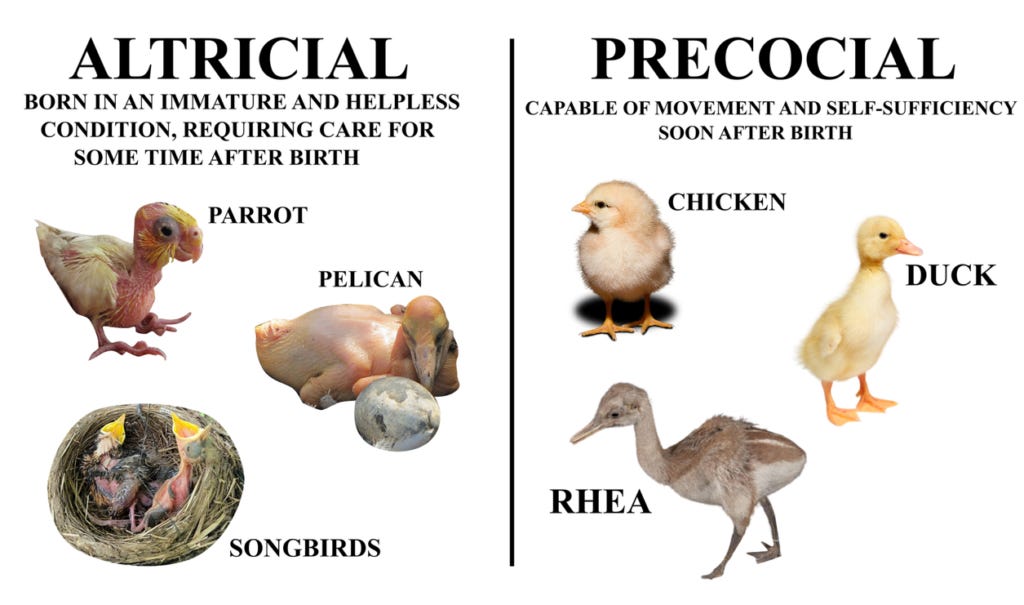
Humans are the most socially altricial species on earth. We’re the most altricial of all the primates, and extraordinarily altricial for our body size. At birth, we can’t roll over, sit up, see clearly, or regulate our body temperature. We must be held, carried, fed, and bathed by others. We are literally bred for dependence.
We are so dependent, in fact, that raising a human baby is usually too much work for just one person to shoulder alone. We humans are alloparents. This means that we naturally parent in community, with multiple helpers on hand to pitch in and share care. That doesn’t always mean fathers—it can also mean grandparents, aunts, uncles, cousins, siblings, and paid caregivers—but fathers are a key part of the alloparenting web that surrounds a new infant and ensures its survival.
In exchange for this sustained period of dependence, we humans get a luxuriously long window of opportunity to build the big social brains that we need in order to coordinate these complex rosters of caregivers. Maintaining alloparental networks requires brains that are well-tuned for empathy and trust, can detect freeloaders and malingerers, and can keep track of reciprocal relationships. Those probabilistic, moral brains didn’t evolve to help us be better at poker, sports, or day-trading. Our brains are built to manage our social worlds, because we simply can’t survive without them.
Our alloparental networks make us more adaptable and resilient to threat. If something happens that prevents a nursing mother from feeding or caring for her infant—death, illness, or even just distraction—the community can step up and ensure the baby’s survival. We humans thrive in all kinds of terrain and through all kinds of adversity because our infants don’t rely on a single parent in order to stay alive. Wet-nurses have been a feature of human societies for as long as we have archeological records. Deborah, Rebekah’s nurse, is featured in the Old Testament, and wet-nurse contracts have been unearthed by archaeologists in both Egypt and Greece. In Rome, you can visit the Columna Lactaria, or Milk Column, a landmark where wet-nurses were hired in ancient times. These records tell us that, across a variety of cultures, even the most intimate forms of mothering were shared with helpers when needed.

This brings us back to fathers. Male alloparents cannot lactate, of course—although fathers in some hunter-gatherer societies have been observed allowing infants to suck on their nipples for comfort. But men can and do perform all the other duties of alloparents. Children get a survival benefit when their fathers are in the picture.
But fathers’ contributions vary across culture and context, according to what’s most needed within their local social worlds. In researching my forthcoming book, Dad Brain: The New Science of Fatherhood and How It Shapes Men’s Lives, I spoke with the anthropologist Barry Hewlett, who studies hunter-gatherer fathers. He has spent years observing the Aka Pygmies, a community within the Congo Basin in which fathers play a major role in hands-on care of infants. Hewlett noted that Aka fathers of infants can be found within arm’s reach of their babies nearly 50 percent of the time. However, Hewlett told me, not every pre-industrial society includes such involved fathers. The traditional fathers of the shepherding Kipsigis tribe, just a day’s journey away in Kenya, don’t interact much with their infants at all, since the society considers it “unmanly” for men to be in the company of babies. Kipsigis men play a role in provisioning, bringing food home to their families, but it’d be odd for a Kipsigis man to feed or change an infant.
This variability is what makes fathers so fascinating, and what has inspired me to study them in my laboratory at the University of Southern California over the last 15 years. Why would fathers look so different in one culture compared to another? In part, fathers’ roles depend on how a community generates the calories it needs to survive. In foraging societies in which both males and females find food, a more egalitarian trade-off of childcare works well. In societies in which resource gathering is more risky, or requires physical strength, a gender-specialized approach to parenting roles makes more sense. The industrial revolution forced a new kind of specialization. Whereas both men and women had contributed to family farms and businesses, the shift of economic activity from households to factories and offices led to a separation of work and home and a new rigidity in gender roles. Men moved into the public sphere of the workplace while women remained in the private world of the home, where they became economically dependent on men. The fatherhood role diminished as men began to work longer hours away from home.
Fatherhood is in flux in many contemporary societies today. Over the last 75 years, women have entered the paid workforce en masse. Now that mothers are contributing income to their families, fathers’ role in childcare has increased, too. According to recent time diary studies, the average daily minutes that men spent in childcare have tripled since the 1960s. Millennial men are more engaged in hands-on fatherhood than their own fathers and grandfathers were.
We know that when dads participate in care, children show better outcomes across a range of domains, from emotional to educational. Indeed, dads can even provide some specific benefits for children. Take play: fathers tend to engage children in more physically stimulating, risk-taking play (think throwing a toddler up in the air and catching them, or pretending to be a monster and chasing a child around). There’s evidence that this type of play can help children build confidence and better regulate their emotions. Having fathers in the household also boosts children’s economic security and is linked with better long-term educational and occupational prospects.
Fathers’ involvement also benefits women’s mental health. One study found when paternity leave was lengthened in Sweden, requests for prescription anti-anxiety medication tumbled by 26 percent among mothers whose babies were born right after the leave reform, relative to mothers whose babies were born right before it. It’s likely that the change reflected moms’ greater access to support. My lab did a similar study, finding that when fathers in our California sample were able to take paid paternity leave, their partners showed healthier prenatal-to-postpartum trajectories of stress and depression. But, as I describe in Dad Brain, the biggest beneficiaries of fatherhood time might be dads themselves, who discover a richer, more connected, and more meaningful life.
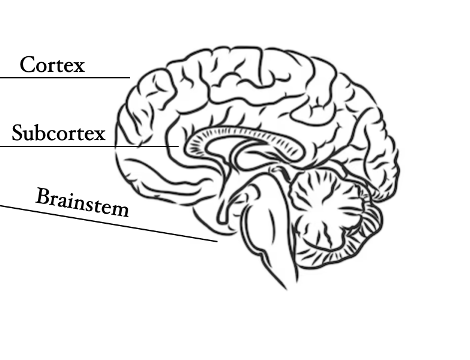
Because of the variability in fatherhood across culture and context, the fathering brain and body are built for adaptation and flexibility. Motherhood comes with plenty of hacks and extra backstops to prepare the brain, like the physical transformations of pregnancy and the hormonal flood of birth and breastfeeding. Fatherhood is more volitional, since fathers are making a deliberate decision about whether to invest in care, one that is shaped by the trade-offs and expectations of their society and community. As such, when we look at the parts of the brain that are most strongly remodeled across the transition to parenthood, women show widespread gray matter change across both the cortex (the top layer of brain tissue that evolved most recently in primates that engages in thinking, reasoning, and planning) and the subcortex (the more hormonally-modulated ancient structures that regulate bodily functions and gut feelings), whereas fathers seem to show the greatest changes in the cortex.
The fathering brain and body, in other words, come online when fathers choose to prioritize parenting, and it is built by repetition and practice. My research finds that fathers who spend more time with their infants in the first months after birth show greater remodeling of the brain, specifically in the parts of the cerebral cortex that engage in social cognition and theory of mind.
Fathers are not just changing their brains; they’re also acquiring new skills through hands-on childcare, and those skills—ranging from better emotion regulation to organization and project management—transfer to enrich their performance in other domains, too. Men who devote energy to becoming great fathers may find that they also become better friends, more efficient workers, and more effective bosses and community leaders. In writing Dad Brain, I spoke to a Silicon Valley executive who told me that when he took a parenting class to learn how to communicate better with his kids, he also became a more capable manager at work.
These days, fathers are arguably more needed in children’s lives than ever before, because our alloparental options have diminished. We have less of a village to support shared childrearing. Many of us live far away from extended family, making grandparent, aunt, uncle, and cousin care harder to find, and norms of neighbor and community care have shifted too. At the same time, we have developed more intensive approaches to parenting, which require closer supervision and monitoring of children. When I was a kid growing up in small-town Ohio in the 1980s, I knocked on neighbors’ doors until I scrounged up a friend who was available and willing to play. Now, children are more likely to spend their downtime in organized activities that require a parent’s active management and monitoring. These changes put more pressure on the nuclear family to fill all of children’s needs. Two people—the mother and father—are now shouldering the caregiving load that used to be distributed among the whole community.
As concerns about family formation and falling birth rates enter our discourse, there have been many calls for a return to traditional, “natural” gender roles, in which women forego higher education and the paid workforce in order to devote themselves to motherhood, while men fill the breadwinner role outside the home. But a strict divide between the home front and the workplace reflects only a brief window in our human history, when the industrial revolution divided the spheres of work and family. Our real heritage is our flexibility and our ability to forge alloparental networks with varying degrees of gender specialization. The fact that men’s brains and bodies can adapt to parenting tells us that nature intended for human babies to have multiple caregivers who are invested in their development.
 | A guest post by
|